

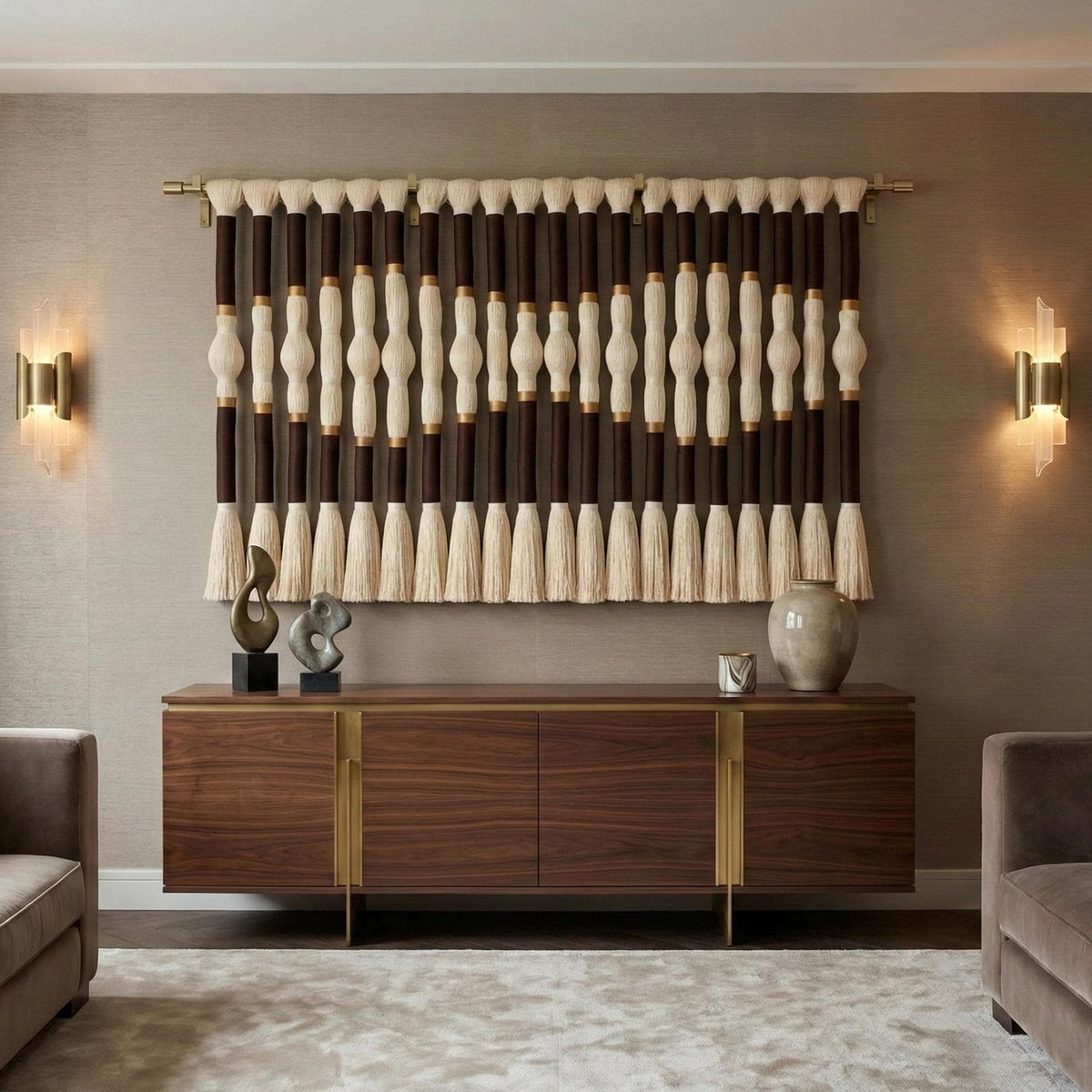
Commissioning large-scale textile art starts with the space: its proportions, sightlines, materials and the way people move through it. For an interior designer planning a hotel reception, a restaurant feature wall or a residential entrance, a useful brief helps turn an initial visual idea into a composition that can be discussed, priced and produced.
This guide explains what to prepare before approaching a textile art studio, how to compare a single artwork with a multi-piece installation, and which practical details to resolve before production.
1. Define the role of the artwork
Begin with one sentence describing what the work should do. It might mark the arrival point in a reception area, bring a softer visual texture to a stone-lined lounge, or create a continuous rhythm along a long wall. That purpose is more useful than a list of broad style labels.
Then identify the principal viewing positions. An artwork encountered from a doorway needs to read from a distance; one beside a seating group can invite closer attention to fibre, wrapping and detail. Photograph the wall from both positions and include nearby furniture, doors and lighting in the frame.
For a wider discussion of reception spaces, see our guide to custom wall art for hotel lobbies.
2. Measure the composition, not just the wall
Record the full wall width and height, then mark the usable area. Skirting, switches, signage, door swings, wall lights and furniture can all change the space available for the artwork. Include an elevation drawing if one is available.
For a group of works, specify the proposed outer dimensions of the entire arrangement as well as the dimensions of each element. The gaps are part of the design. Five narrow pieces spread across a wall can have a very different presence from the same pieces placed closely together.
A simple planning example: five elements, each 10 cm wide, with four 20 cm gaps create a 130 cm-wide arrangement before any outer margins are added. This is a layout calculation, not a recommended spacing for every project. Marking the outline with paper templates can help the design team judge the composition at full scale.
3. Choose a single statement piece or a modular arrangement
A single textile artwork establishes a clear focal point. A modular composition lets the eye move between repeated forms, changing lengths and areas of open wall. Neither approach requires filling every available surface.
- Single artwork: consider it when the wall has one clear centre, such as a framed architectural recess or the space behind a reception desk.
- Grouped textile forms: consider them when repetition, varied heights or a wider composition would relate to the architecture.
- Coordinated works in several locations: define which characteristics should repeat, such as palette or material, and which can vary by room.
Sarmal Design’s Graduated Textile Wall Tubes — Set of 5 offers an example of varied lengths within a single textile composition. Its listed lengths are 120, 100, 80, 60 and 40 cm. It is an existing collection piece, not a specification for every large installation; a different scale or arrangement requires a separate discussion.
4. Build a focused colour and material brief
Send a small selection of relevant references: the wall finish, flooring, upholstery and any nearby metal or timber details. Identify the dominant colour and the accent you want the artwork to introduce. Explain whether the textile should sit quietly within that palette or create a visible contrast.
Digital images are useful for discussing direction, but screens and lighting can change the appearance of colour. Ask how the selected materials and finishes will be reviewed before production. Where colour matching matters, agree on an appropriate approval method rather than relying on a single screen image.
Explore the Wall Tubes collection for examples of sculptural textile forms. Custom dimensions, colours and compositions depend on the selected design and materials and must be confirmed for the project.
5. Plan lighting, access and mounting together
Textile relief and cylindrical forms create shadows, so include the lighting layout in the brief. Note whether the work will receive daylight, a nearby wall light or directional illumination. Review the proposed placement from the side as well as from the front: depth matters beside a circulation route.
Ask the studio for the weight, projection and mounting information for the agreed artwork. The project’s installer should assess the wall construction and suitable fixings. Hardware supplied with a collection piece should not be assumed suitable for every substrate or larger custom arrangement.
For hospitality and other commercial settings, share the project’s material, maintenance and documentation requirements at the enquiry stage. A textile artwork should not be specified as an acoustic treatment or as fire-rated on appearance alone; any required performance needs supporting documentation for the actual materials and construction.
6. Separate the artwork budget from the installation plan
A useful enquiry gives a budget range and identifies what it needs to cover. Design development, the artwork, packing, transport, local installation and access equipment may be handled by different parties. Clarify the scope of the quotation rather than assuming every service is included.
Share the required installation date, delivery location and site-access constraints. Custom production timing depends on the final design, scale, quantity and destination. Allow the studio to review the project before treating a standard product lead time as a commitment for a larger commission.
A brief you can send to a textile art studio
Gather these details into one email or project document:
- Project name, location and type of space.
- The role of the artwork and the principal viewing positions.
- Wall dimensions, photographs and a marked elevation.
- Preferred overall composition, approximate dimensions and quantity.
- Palette, material references and links to relevant collection pieces.
- Wall construction, lighting, available depth and access information.
- Any required technical documentation or maintenance constraints.
- Budget range, delivery deadline and the person approving the design.
Frequently asked questions
Can textile wall art be customised for a large wall?
Selected designs can be discussed in different dimensions, colours or groupings. Feasibility depends on the construction and materials. Share the proposed overall dimensions so the studio can review the request before quoting.
Is one large artwork better than several smaller pieces?
The answer depends on the architecture and intended focal point. A single piece creates a concentrated composition; a group can introduce rhythm and respond to a wider or irregular wall. Compare both on an elevation before deciding.
What should be agreed before production?
Confirm the design, dimensions, materials, colour approval process, price, schedule and delivery scope in writing. Request the mounting and care information needed by the project team, and clarify who will install the work.
Discuss your project with Sarmal Design
Sarmal Design creates handcrafted wall art and sculptural objects in Ankara, Türkiye. Interior designers, architects, art consultants and hospitality teams can enquire about selected collection pieces or the possibilities for a custom composition.
Visit our interior designer project page for the enquiry process, or send your dimensions, mood board and intended installation date to deniz@sarmaldesign.com. You can also contact the studio to start the conversation.


