

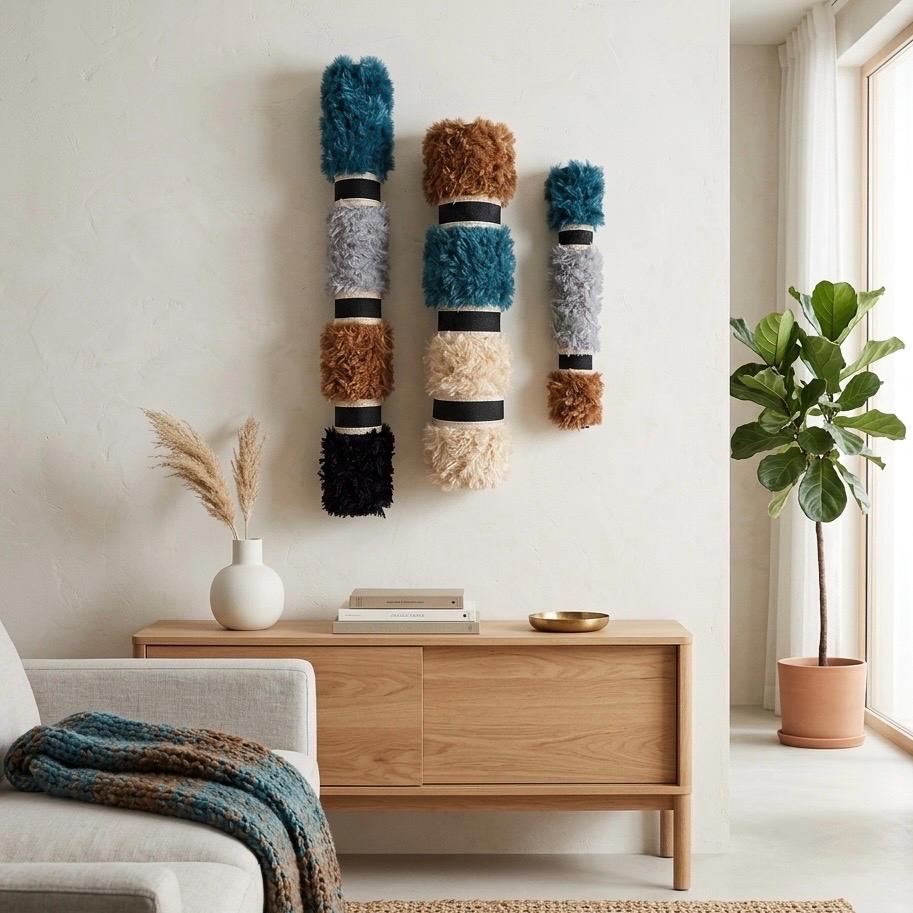
A narrow wall is easy to overlook. It may sit between two doors, beside a window, at the end of a hallway or alongside a compact console. Although the available width is limited, the wall can still support a deliberate artwork when proportion, depth and spacing are planned together.
Vertical wall art works differently from a wide composition above a sofa. Instead of spreading across the room, it uses height to create rhythm. Textile sculpture can add another dimension: fiber, wrapped surfaces and shadows introduce detail without requiring a broad wall.
This guide explains how to choose vertical wall art for narrow walls and how modular Wall Tubes can be arranged around the architecture of a space.
Start With the Usable Wall, Not the Total Wall
Measure the clear area available for art rather than the complete width of the wall. Door frames, switches, wall lights, trim and nearby furniture can reduce the usable space.
Record:
- Clear wall width and height
- Distance from nearby doors, windows and furniture
- The wall or partition construction
- Available depth in the circulation area
- The main viewing position
- Any lighting that may create shadows
Depth is particularly important in a hallway or passage. Sculptural artwork projects into the room, so confirm that the composition will remain clear of doors, people and frequently used furniture.
Mark the proposed outer boundary with removable paper before ordering. View the mock-up from the entrance to the room as well as directly in front of the wall.
For a broader approach to measuring an undecorated surface, see our guide to decorating a large empty wall.
Choose Between One Vertical Form and a Grouped Composition
One tall artwork creates a calm focal point. A grouped composition introduces more movement and allows the outer shape to respond to architectural details.
Separate Wall Tubes can be arranged as:
- A close vertical cluster
- A descending or ascending sequence
- An offset group with varied starting heights
- A compact composition above a narrow console
- A taller arrangement between architectural openings
The goal is not to fill every centimetre. Open wall around the artwork helps each form remain visible and keeps a narrow space from feeling crowded.
Sarmal Design’s Wall Tubes collection includes cylindrical textile forms in different lengths, surfaces and colour combinations. Because the pieces project from the wall, changing daylight and side lighting become part of the composition.
Use Repeated Forms to Create Vertical Rhythm
Repeated cylindrical forms can make a small area feel intentional. Similar materials connect the pieces, while changes in length introduce movement.
The Banded Textile Wall Tubes — Set of 3 includes three lengths: 100, 80 and 60 cm. Their different diameters and contrasting bands create a defined vertical sequence without relying on a wide rectangular outline.
A three-piece arrangement can suit a wall where a larger collection would feel busy. Before installation, test whether the pieces should share one upper line or begin at slightly different heights. The second approach usually creates more movement, while a shared alignment feels more architectural.
Consider a Flexible Five-Piece Arrangement
A five-piece set provides more control over the overall silhouette.
The Tufted Cylinder WallTubes — Set of 5 contains three 75 cm pieces, one 50 cm piece and one 25 cm piece. The product can be arranged vertically or horizontally, allowing the composition to respond to the wall rather than forcing the wall to suit a fixed frame.
For a narrow wall, the pieces can be kept relatively close and organised around a strong vertical centre. On a wider wall, the same forms can be spread out to create a more open rhythm.
Always measure the complete proposed installation, including the spaces between the individual pieces. The dimensions of one cylinder do not describe the final footprint of the group.
Use Graduated Lengths on Taller Walls
Some narrow walls have limited width but generous height. These are often found beside staircases, between tall windows or near double-height entrances.
The Graduated Textile Wall Tubes — Set of 5 includes lengths of 120, 100, 80, 60 and 40 cm. The gradual change in length can create a flowing silhouette while keeping the composition visually connected.
Test the longest piece first. Once its position feels balanced, place the shorter forms around it. This is easier than beginning with every piece at once.
Avoid positioning the longest element so close to the floor, console or skirting that the composition appears compressed. The full paper mock-up should include the lowest and highest visible points.
Think About Depth and Shadow
Wall Tubes do not behave like flat prints. Their cylindrical forms project outward and produce changing shadows.
Before deciding on placement:
- Check the available depth in the room.
- View the mock-up from the direction people normally approach.
- Observe the wall in both daylight and evening light.
- Confirm that nearby lighting will not create distracting or excessively sharp shadows.
- Keep the artwork clear of door swings and circulation routes.
Side lighting can reveal the rounded profiles and wrapped surfaces more clearly. More frontal lighting creates a flatter and quieter appearance. Neither is automatically better; the right choice depends on whether the artwork should become a focal point or sit more gently within the room.
Select Colour After Establishing the Shape
On a narrow wall, begin by establishing the proposed height, spacing and outer boundary before comparing palettes.
A restrained palette can keep a multi-piece composition calm. A contrasting band or deeper colour can draw attention to the vertical movement.
Look for one connection with the room:
- A tone found in nearby upholstery
- A colour repeated from stone or timber
- A warm neutral related to the flooring
- A controlled contrast against the wall paint
Selected Sarmal Design works can be discussed in alternative colours or compositions. Available options depend on the construction and materials of the individual design.
Confirm the Mounting Method for the Selected Work
Mounting requirements vary between artworks and wall constructions. Do not select fixings solely from a styled room photograph.
The Banded Textile Wall Tubes and Tufted Cylinder WallTubes listings include mounting hardware, but the intended wall surface should still be reviewed before installation. Plasterboard, masonry and timber surfaces may require different preparation.
For an interior project, provide:
- A straight-on photograph of the wall
- Wall width and height
- Wall or partition construction
- The preferred arrangement
- Nearby furniture dimensions
- Project location and installation date
If the wall construction or load capacity is uncertain, consult a qualified installer before drilling or mounting the artwork.
Where Vertical Wall Art Can Work
Vertical textile art can be considered for:
- Narrow entrance walls
- Hallways and circulation areas, with suitable clearance
- Spaces between windows
- Walls beside wardrobes or shelving
- Compact reception areas
- Staircase walls, subject to access and mounting review
- Small walls above a console or bench
For minimalist rooms, the texture and shadow of the artwork can provide detail without introducing many separate decorative objects. See Textured Wall Art for a Minimalist Living Room for more guidance on combining fiber art with furniture, colour and light.
For hospitality settings, our guide to custom wall art for hotel lobbies covers project scale, guest viewpoints and installation planning.
A Short Narrow-Wall Checklist
Before selecting vertical wall art, confirm:
- The usable width and height
- The depth available in the room
- The complete footprint of all pieces and gaps
- The viewing direction
- The wall construction
- The preferred palette
- The mounting requirements for the selected artwork
A narrow wall does not need to remain empty or be filled with several unrelated small objects. A carefully planned vertical composition can give it a clear role within the room.
Discuss a Wall Tube Composition for Your Space
Explore the complete Wall Tubes collection, or send us a photograph of your wall with its width, height, preferred palette and project location.
Interior designers, architects and hospitality teams can also use our For Interior Designers page to discuss custom dimensions, colours and coordinated compositions.
Frequently Asked Questions
What type of art works on a narrow wall?
Artwork with a vertical silhouette usually uses the available height more effectively than a wide horizontal piece. One tall textile work or a closely grouped set can create a focal point while leaving open wall around it.
Can Wall Tubes be arranged vertically?
Yes. Several Wall Tube compositions can be installed vertically, and the Tufted Cylinder WallTubes set may also be considered in horizontal arrangements. Plan the complete outer footprint before mounting.
Is mounting hardware included?
Mounting hardware is included with selected designs, including the Banded Textile Wall Tubes and Tufted Cylinder WallTubes. Confirm the product details and the suitability of the fixings for your wall construction.
Can the colours be customized?
Selected Wall Tube compositions may be discussed in alternative colours or quantities. Feasibility, price and production timing are confirmed before a custom order is placed.
How should I measure a narrow wall?
Measure the clear width between trim, doors or other architectural elements, then record the available height and depth. Include switches, lighting and furniture in the drawing or photograph you send.


